China remains the world’s largest automotive parts manufacturing hub, accounting for over 35% of global auto parts production. For international buyers, sourcing from China offers significant cost advantages — typically 20–40% lower than domestic suppliers in Europe or North America — along with access to a vast ecosystem of specialized manufacturers.
However, finding the right supplier requires due diligence. This 2026 guide provides a step-by-step framework for evaluating and selecting a reliable OEM auto parts manufacturer in China.
The China Advantage for Auto Parts Sourcing
Why do global automotive companies continue to source from China?
- Cost competitiveness — lower labor and overhead costs translate to 20–40% savings
- Established supply chain — complete ecosystem from raw materials to specialized components
- Manufacturing flexibility — ability to handle both high-volume production and small-batch custom work
- Technical capability — many Chinese manufacturers now meet or exceed global quality standards
- Export infrastructure — well-developed logistics networks, especially from Zhejiang and Guangdong provinces
Step 1: Define Your Requirements Clearly
Before contacting any supplier, you must have a clear specification package. This includes:
- Technical drawings — 2D dimensional drawings with tolerances and 3D models (STEP/IGES preferred)
- Material specifications — exact grade of steel, rubber compound, or plastic required
- Quality standards — which ISO/IATF standards apply, plus any customer-specific requirements
- Annual volume estimates — expected quantity per part number per year
- Target price range — realistic budget based on market research
- Packaging and labeling requirements — important for logistics and retail display
- Certification needs — material certificates, test reports, country of origin documentation
Tip: The more detailed your requirements, the more accurate the supplier’s quotation will be. Vague specifications lead to pricing surprises and quality issues later.
Step 2: Research Potential Suppliers
B2B Platforms
- Alibaba.com — largest platform; use the "Verified" and "Assessed" supplier filters
- Made-in-China.com — strong for industrial components
- Global Sources — higher quality filter, many mid-to-large manufacturers
Trade Shows
- Automechanika Shanghai — the largest automotive aftermarket fair in Asia (December)
- Canton Fair (Phase 2) — broad range of manufacturers (April/October)
- CIAPE (China International Auto Parts Expo) — specialized auto parts exhibition
Referrals and Industry Networks
- Industry associations — CAAM (China Association of Automobile Manufacturers)
- Trade commissions — Chinese Chamber of Commerce in your country
- Existing supplier referrals — word-of-mouth from trusted partners
Step 3: Verify Certifications
| Certification | What It Means | Who Needs It |
|---|---|---|
| IATF 16949 | Basic quality management system; documents processes and continuous improvement | All manufacturers |
| IATF 16949 | Automotive-specific QMS; required for Tier 1/2 suppliers | OEM direct suppliers |
| ISO 14001 | Environmental management system | European customers, green procurement |
| CE / E-mark | European conformity for automotive components | Export to EU markets |
| SAE J / DIN | Specific component standards (e.g., SAE J403 for steel) | Depends on component type |
Verify the certificate! Request a copy of the certification certificate and verify it with the issuing body. Counterfeit certificates are unfortunately common. Check the certification body’s online database for validity.
Step 4: Factory Audit Checklist
An on-site or virtual factory audit is essential before placing production orders. Key areas to evaluate:
Production Capability
- Machine inventory and age of equipment
- Production capacity (actual vs. claimed)
- Automation level and process control systems
- Tooling and mold-making capability (in-house vs. outsourced)
Quality Control
- Incoming material inspection procedures
- In-process quality checks and control points
- Measuring equipment (CMM, hardness testers, tensile testers)
- Calibration records and frequency
- Non-conformance and corrective action system
Management Systems
- Organizational structure and quality policy
- Employee training records
- Document control and traceability systems
- Production planning and inventory management
Step 5: Sample Evaluation Process
Never skip the sample stage. Follow this process:
- Request production samples — not prototype samples; pieces made on the actual production line
- Check dimensional accuracy — measure critical dimensions against your drawings
- Material verification — send samples to an independent lab for material composition testing
- Fitment testing — test the sample on an actual vehicle or test fixture
- Performance testing — if applicable, test load capacity, fatigue life, or sealing performance
- Document results — create a sample approval report for your records
Step 6: Quality Control and Production Monitoring
Ongoing quality assurance is critical for production orders:
- Pre-production meeting — review all requirements before production starts
- First Article Inspection (FAI) — inspect the first pieces from each production run
- In-process inspection — visit or video-call during production for mid-run checks
- Final random inspection — use AQL (Acceptable Quality Level) sampling (AQL 2.5 or 1.0)
- Third-party inspection — hire firms like SGS, Bureau Veritas, or TUV for independent QC
Step 7: Logistics and Shipping
| Shipping Method | Transit Time | Cost | Best For |
|---|---|---|---|
| Sea Freight (FCL) | 25–40 days | Lowest per unit | Large orders, full containers |
| Sea Freight (LCL) | 25–40 days | Moderate | Smaller orders |
| Air Freight | 5–10 days | High (3–5x sea) | Urgent orders, samples |
| Express (DHL/FedEx) | 3–7 days | Highest | Samples, small packages |
Key incoterms to understand: FOB (Free on Board) is most common for Chinese exports. EXW (Ex Works) gives you more control but requires you to arrange all logistics.
Red Flags to Watch Out For
- Unrealistically low prices — if it seems too good to be true, corners are being cut somewhere
- Reluctance to provide certifications — legitimate suppliers readily share their credentials
- No factory photos or videos — request a live video tour if an on-site visit is not possible
- Poor English communication — while not a deal-breaker, it increases the risk of misunderstandings
- Refusal to use a formal contract — always use a written purchase agreement with clear specifications
- Demand for full payment upfront — typical terms are 30% deposit, 70% before shipment
- Inconsistent branding — check if the company name matches its trade license and website domain
Why Chilong Bearing Technology Stands Out
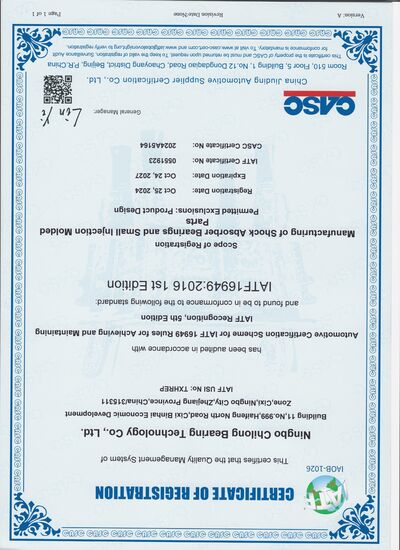
Ningbo Chilong Bearing Technology Co., Ltd. offers international buyers a reliable, IATF 16949 Certified manufacturing partner:
- 15+ years of OEM/ODM experience in automotive suspension components
- 5,000 m² modern manufacturing facility with dedicated R&D and QC departments
- IATF 16949 certified quality management system
- Export to 30+ countries including Europe, North America, Southeast Asia, and the Middle East
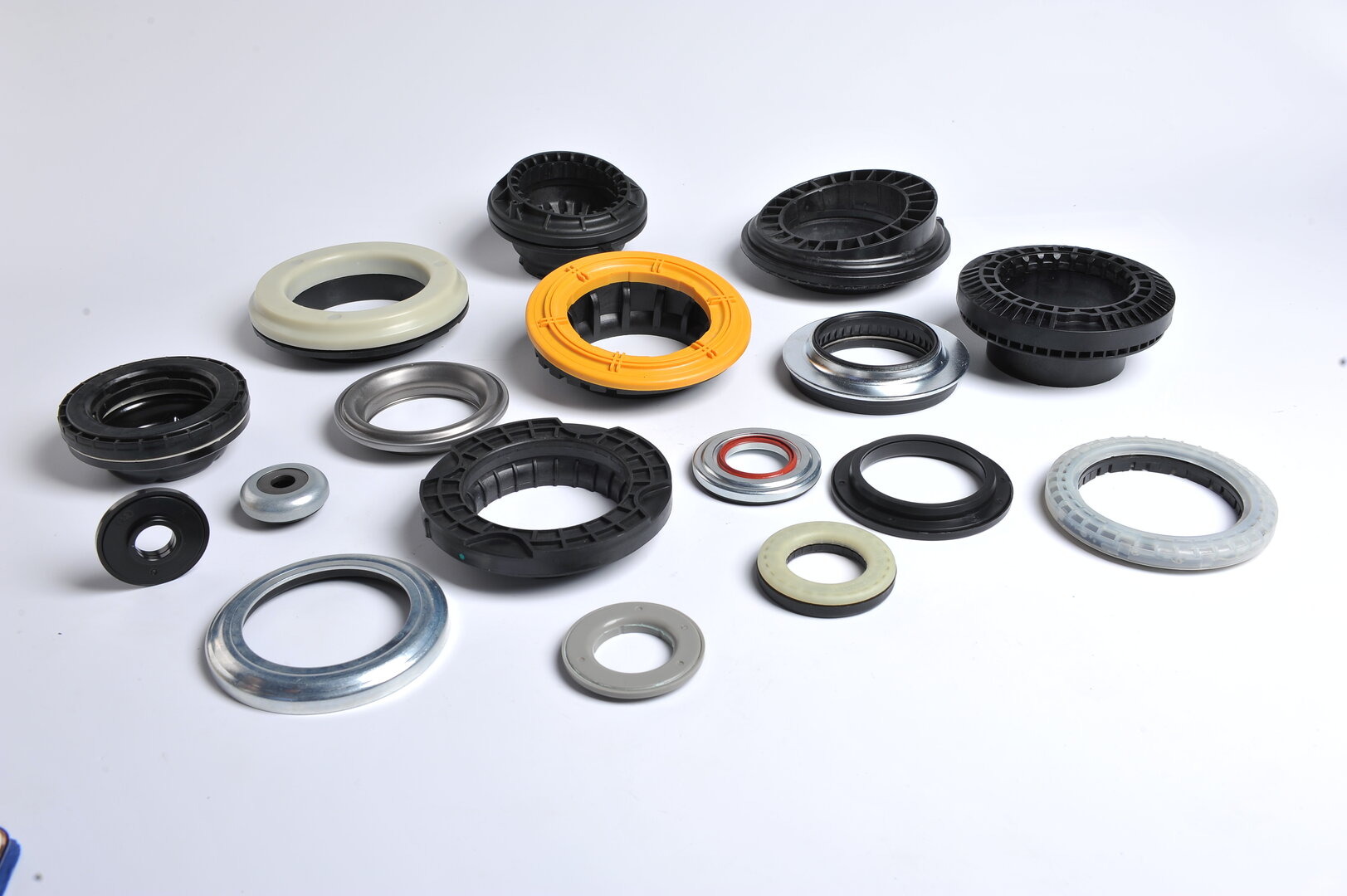
- Complete product range — shock absorber bearings, top mounts, dust covers, bump stops, bushings
- Custom manufacturing — we work with customer drawings and samples to produce custom components
- Flexible MOQ — accommodating both large OEM contracts and smaller distribution orders
- Full documentation — material certificates, dimensional reports, and quality test data included
Frequently Asked Questions for First-Time Importers
What is the typical MOQ for custom auto parts from China?
MOQs vary by product complexity. For standard bearings and bushings, MOQs range from 500–2,000 pieces per part number. Custom-molded rubber components may require 1,000–5,000 pieces due to mold tooling costs. Chilong Bearing offers flexible MOQs for new partnerships.
How do I protect my intellectual property when sourcing in China?
Use a non-disclosure agreement (NDA) before sharing detailed designs. Consider registering your design patents in China. Split production across multiple suppliers for critical components. Chilong Bearing respects customer IP and operates under strict confidentiality agreements.
Do I need to speak Chinese to work with Chinese suppliers?
No — most export-oriented manufacturers have English-speaking sales staff. However, technical discussions may benefit from a translator or bilingual engineer. For complex projects, consider hiring a sourcing agent or third-party inspection company.
What are common payment terms for auto parts suppliers in China?
The most common terms are 30% deposit by wire transfer (T/T) and 70% balance before shipment. Confirmed L/C (Letter of Credit) is also used for large orders. For new relationships, start with smaller orders to build trust before negotiating better terms.
How long does tooling take for custom auto parts?
Tooling lead times vary by complexity. Simple compression molds can be ready in 4–6 weeks. Complex injection molds or progressive dies may take 8–12 weeks. Factor in time for sample approval (2–4 weeks) before production begins.
Conclusion
Sourcing OEM auto parts from China offers significant competitive advantages, but success requires systematic evaluation and ongoing quality management. By following the seven steps outlined in this guide — from defining requirements to managing logistics — you can build a reliable supply chain that delivers quality parts at competitive prices.
If you are looking for a trusted partner for shock absorber bearings, top mounts, bushings, or custom suspension components, contact Chilong Bearing Technology. With over 15 years of OEM experience and IATF 16949 certification, we are ready to support your automotive parts sourcing needs.
Need Expert Advice?
Contact our team for professional guidance on your suspension component requirements. We're here to help with OEM/ODM projects, custom manufacturing, and technical consultation.
Contact Our Team