In modern MacPherson strut suspension systems, the strut mount — also called the top mount, strut top mount, or suspension mount — is a small component that plays an outsized role in vehicle ride quality, handling, safety, and NVH (Noise, Vibration, Harshness) performance.
This comprehensive guide is written for automotive engineers, purchasing professionals, workshop technicians, and aftermarket distributors who need a thorough understanding of what strut mounts are, how they work, what types exist, how to specify the right product, and what sets quality OEM and aftermarket mounts apart.
What Is a Strut Mount?
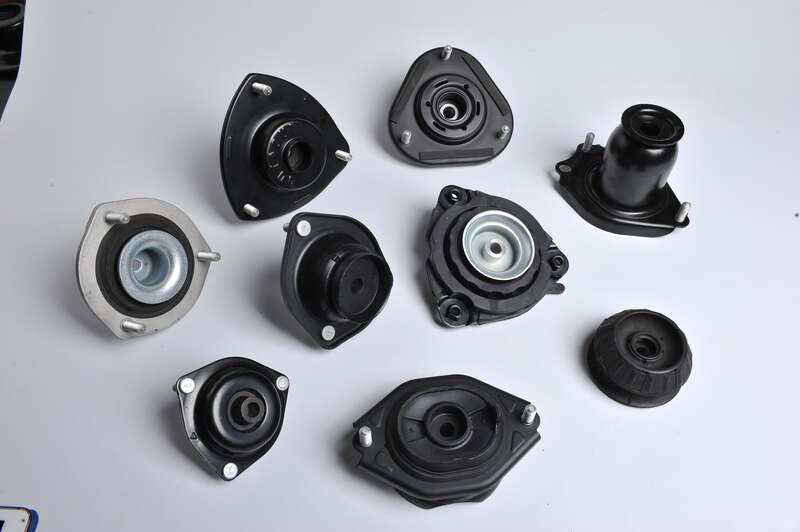
A strut mount (top mount) is the structural component that connects the top of a MacPherson strut assembly to the vehicle's chassis. It is typically a rubber-to-metal bonded assembly that sits between the strut piston rod and the body's strut tower. In front suspension applications, the mount often includes an integrated bearing (strut bearing or top mount bearing) that allows the strut to rotate with the steering knuckle.
Key definition: The strut mount is the load-bearing interface between the suspension strut and the vehicle body. It performs three simultaneous jobs: load transmission, vibration isolation, and (in front applications) steering articulation.
How Strut Mounts Work
A strut mount accomplishes its functions through a carefully engineered combination of materials and geometry:
1. Rubber Vibration Damping
The rubber element (typically natural rubber or a proprietary compound) acts as an elastic isolator. It absorbs high-frequency road vibrations transmitted up the strut piston rod, preventing them from reaching the cabin. The rubber's dynamic stiffness, damping coefficient, and durometer (hardness) are tuned for each vehicle application to balance ride comfort with handling precision.
2. Bearing Rotation (Front Applications)
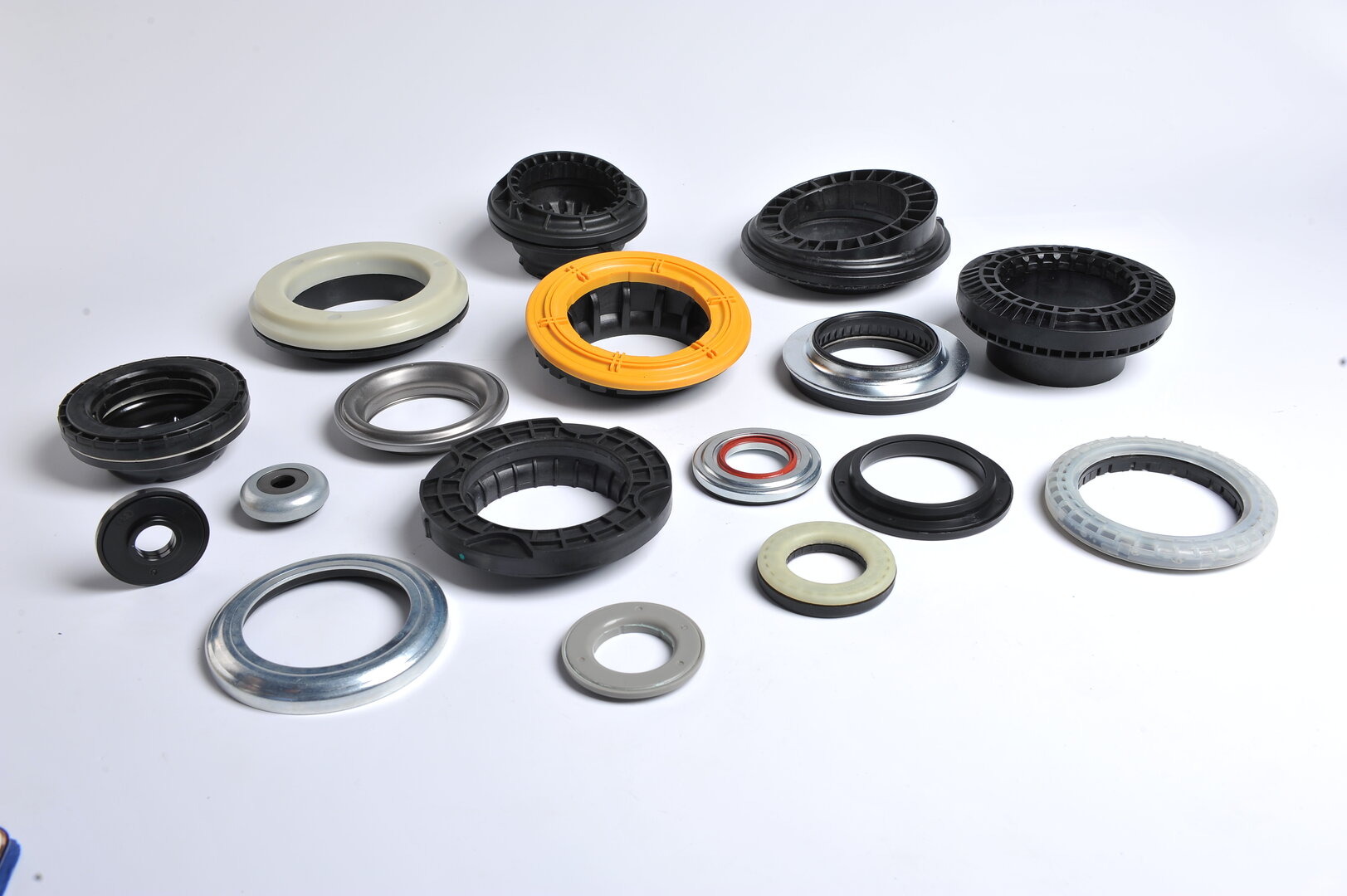
For front suspension top mounts, an integrated thrust bearing sits between the rubber isolator and the chassis mounting point. This bearing allows the strut assembly to rotate freely when the steering wheel is turned. The bearing must handle both axial loads (vehicle weight) and radial steering forces while maintaining low friction for responsive steering feel.
3. Load Transmission
The mount transfers the vehicle's corner weight from the coil spring (through the strut) into the chassis structure. During cornering, braking, and acceleration, the mount also transmits lateral and longitudinal forces. The steel core provides the structural strength to handle these loads, while the rubber isolates the chassis from impact energy.
Types of Strut Mounts
Strut mounts come in several design variants, each suited to different vehicle types and performance requirements:
1Standard Rubber Mount
The most common type, used on economy and mid-range vehicles. Consists of a natural rubber (NR) isolator bonded to a stamped steel plate. May include a separate press-in bearing for front applications. Cost-effective and provides adequate NVH isolation for standard driving conditions.
2Bearing-Integrated Mount
A pre-assembled unit combining the rubber isolator and a sealed angular contact ball bearing into a single replacement part. Eliminates the risk of incorrect bearing installation. Used widely on modern passenger cars and SUVs. The bearing is typically pre-lubricated and sealed for the life of the component.
3Reinforced / Heavy-Duty Mount
Designed for commercial vehicles, heavy SUVs, and performance applications. Features a thicker rubber section, higher-durometer compound, and a reinforced steel core capable of handling increased load ratings. Often includes additional brazing or welding at the rubber-to-metal bond interface to prevent separation under extreme loads.
4Active Suspension Mount
Used in vehicles with electronic or adaptive suspension systems. May incorporate sensors, variable-rate damping valves, or electrical connectors. These mounts are more complex and expensive, requiring precise alignment with the vehicle's electronic control unit (ECU). Common in luxury sedans and high-end SUVs.
Material Construction
The materials used in strut mount manufacturing directly determine performance, durability, and cost:
| Material | Properties | Applications | Durability |
|---|---|---|---|
| Natural Rubber (NR) | Excellent elasticity, high tear strength, good damping | Standard passenger vehicles | ★★★★☆ |
| NR + Steel Bonded | Superior load capacity, consistent NVH performance | Most OEM applications | ★★★★★ |
Key Specifications for B2B Buyers
When sourcing strut mounts for OEM or bulk aftermarket projects, automotive buyers should evaluate the following specifications:
| Parameter | Typical Range | Why It Matters |
|---|---|---|
| Static Load Rating | 400 - 1,200 kg per mount | Must support the corner weight of the vehicle with safety margin |
| Dynamic Load Capacity | 600 - 2,000 kg | Handles peak forces during cornering, braking, and impact |
| Rubber Hardness (Shore A) | 50 - 75 Shore A | Lower = softer ride, higher = sportier handling |
| Operating Temperature Range | -40°C to +85°C | Must maintain performance across all climates |
| Bearing Axial Play | < 0.15 mm | Excessive play causes noise and premature wear |
| Bond Strength (Rubber to Metal) | > 20 N/mm peel resistance | Prevents rubber separation from steel core |
| Torque Retention | > 80% after thermal cycling | Ensures mounting bolts stay tight over service life |
| Salt Spray Resistance | > 240 hours | Corrosion protection for steel components |
Common Failure Modes and Prevention
Understanding why strut mounts fail helps buyers specify better products and workshop technicians make accurate diagnoses:
- Rubber fatigue / cracking: Caused by repeated stress cycles and ozone exposure. Prevention -- use high-grade NR with anti-ozonant additives.
- Rubber-to-metal bond separation: The most dangerous failure mode. Caused by poor bonding process or excessive load. Prevention -- specify IATF 16949 certified suppliers with proven bond integrity testing.
- Bearing wear / roughness: Contamination ingress or insufficient lubrication. Prevention -- sealed, pre-lubricated bearings with labyrinth seal design.
- Steel core corrosion: Exposure to road salt and moisture. Prevention -- e-coating or zinc plating with minimum 240-hour salt spray rating.
- Sag / compression set: Rubber permanently deforms under sustained load. Prevention -- use low compression-set rubber compounds.
Replacement Intervals
Industry guidelines recommend strut mount inspection every 20,000 km and replacement every 50,000 - 80,000 km, or whenever shock absorbers are replaced. Key considerations:
- Front mounts wear faster than rear mounts due to steering loads
- Vehicles driven on poor road surfaces may need replacement at 40,000 km
- Heavy vehicles (SUVs, vans, trucks) experience accelerated mount wear
- Always replace mounts in pairs on the same axle
- Best practice: replace mount + bearing + bump stop + dust cover simultaneously
OEM vs Aftermarket Quality Differences
The gap between OEM-quality aftermarket mounts and budget alternatives can be substantial:
| Quality Aspect | OEM / Premium Aftermarket | Budget Aftermarket |
|---|---|---|
| Rubber compound | High-grade NR with anti-ozonant | Recycled rubber or SBR blend |
| Steel grade | SPHC / SPHE (deep drawing steel) | Lower-grade steel, thinner gauge |
| Bond process | Chemically bonded with adhesive primer | Mechanical only, prone to separation |
| Bearing | Sealed, pre-lubricated, OE-grade | Unsealed, dry, higher friction |
| Dimensional tolerance | ±0.3 mm | ±0.8 mm or worse |
| Testing | 100% load + rotation tested | Sample testing only |
| Service life | 60,000 - 100,000 km | 20,000 - 40,000 km |
Chilong's Strut Mount Production Capabilities
Ningbo Chilong Bearing Technology Co., Ltd. is an experienced manufacturer specializing in suspension components for the global automotive market. Our strut mount production capabilities include:
- NR rubber compounding: In-house rubber formulation laboratory developing proprietary NR compounds optimized for specific vehicle applications. We control the full compounding process from raw rubber selection to vulcanization parameters.
- Steel core stamping: Precision stamping using progressive dies with ±0.1 mm tolerance. Steel thickness ranges from 2.0 mm to 6.0 mm depending on load requirements.
- Rubber vulcanization: Compression molding and injection molding capabilities with automated curing presses. Temperature, pressure, and cure time are computer-controlled for batch-to-batch consistency.
- Bearing assembly: Class 10,000 clean room for bearing integration. Each bearing is tested for rotational torque, axial play, and noise before final assembly.
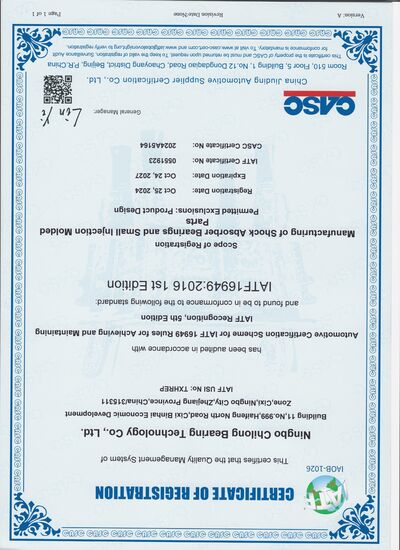
- IATF 16949 certified: Our quality management system covers incoming material inspection, in-process quality control, and 100% final testing for critical parameters.
- Production volume: Monthly capacity exceeding 200,000 units across 200+ vehicle models.
How to Specify Custom Strut Mounts for OEM Projects
For OEM or ODM projects, proper specification is critical. Here are the key steps:
- Define load requirements: Provide static corner weight and expected dynamic load factors. Include worst-case scenario for pothole impact.
- Specify dimensional constraints: Provide 3D CAD or 2D drawing of the strut tower mounting area, piston rod diameter, and overall height limits.
- Choose mount type: Standard rubber, bearing-integrated, or heavy-duty based on vehicle category and performance targets.
- Set rubber hardness target: Typically 55-65 Shore A for comfort-oriented vehicles, 65-75 Shore A for sportier tuning.
- Define bearing requirements: Include rotational torque specification, axial play tolerance, and noise limit (typically < 40 dB at 100 RPM).
- Request prototype samples: Minimum 10 pieces for dimensional verification, load testing, and vehicle fitment check.
- Agree on testing protocol: Fatigue testing (100,000+ cycles), temperature cycling (-40°C to +85°C), salt spray testing, and bond integrity testing.
- Confirm packaging and labeling: OEM packaging with barcode tracking, MOQ, and lead time.
Need custom strut mounts for your OEM project? Chilong offers full ODM support from concept design through production. Contact our engineering team with your specifications for a rapid quotation and sample lead time.
Frequently Asked Questions
There is no functional difference -- "strut mount" and "top mount" refer to the same component. "Strut mount" is the more technical term used in engineering contexts, while "top mount" is common in the aftermarket and workshop environment. Other names include "suspension mount," "shock mount," and in front applications, "bearing mount."
Driving with a failing strut mount is not recommended and can be dangerous. A severely worn mount can cause loss of steering control, uneven tire wear that can lead to blowouts, and in extreme cases, the strut can punch through the mount, causing complete suspension collapse. If you suspect strut mount failure, have it inspected immediately and replaced at the earliest opportunity.
Professional replacement of front strut mounts typically takes 1.5 to 2.5 hours per side, including the necessary wheel alignment. Rear mounts are generally faster at 1 to 1.5 hours per side. The total time depends on the vehicle design.
Yes, a wheel alignment is strongly recommended after replacing strut mounts, particularly on the front axle. Removing and reinstalling the strut assembly can alter camber and caster angles. Only a professional alignment can ensure proper tire wear, straight-line tracking, and accurate steering response.
Premature bearing failure is typically caused by: (1) Contamination -- dirt and water ingress through inadequate sealing, common with budget mounts; (2) Overloading -- using a standard mount on a heavy vehicle; (3) Improper installation -- over-torquing the piston rod nut; (4) Lack of lubrication. Using a premium sealed-bearing mount from a certified manufacturer eliminates most of these failure modes.
Need Expert Advice on Strut Mounts?
Our team of suspension specialists can help you select the right top mount for your application. Contact us for technical support, OEM/ODM inquiries, or bulk pricing.
Contact Our Team